
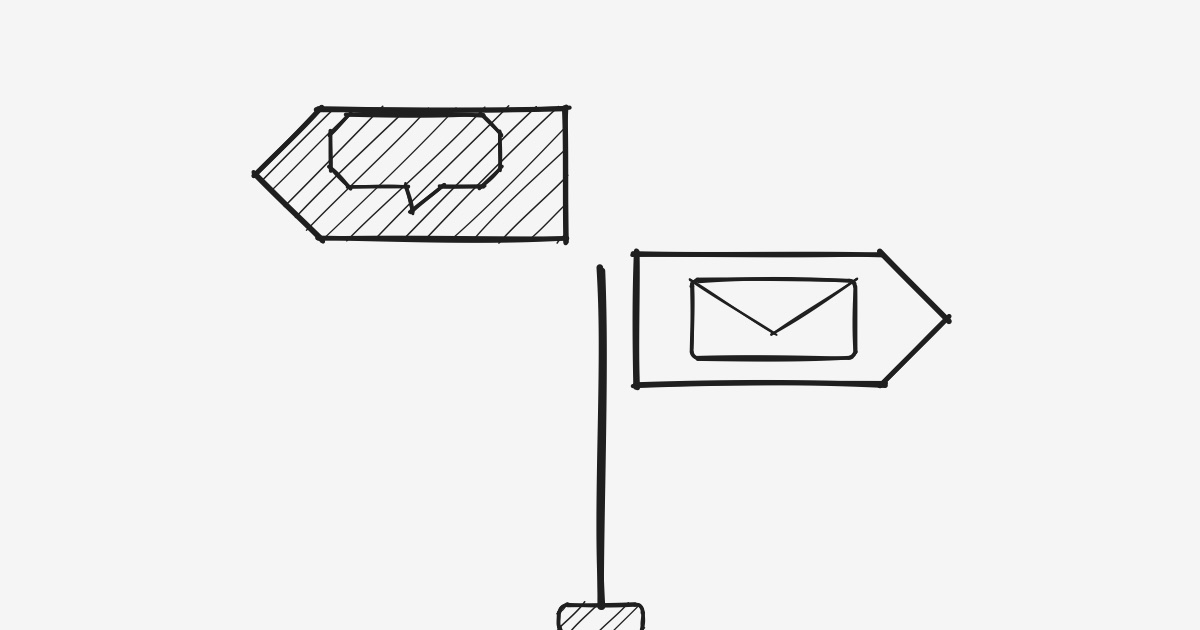
Everyone knows the joke. Almost nobody has a rule — which is why the joke keeps being true.
The problem isn't that people love meetings. It's that "should this be a meeting?" gets answered by instinct, under time pressure, by whoever is about to send the invite. Instinct says yes, because a meeting feels like progress and writing feels like work.
A rule takes ten seconds and beats instinct every time.
Contents
- The three-question test
- What each answer means in practice
- What to replace the usual suspects with
- Writing is slower to produce and faster to consume
- When you keep the meeting, shrink it
- FAQ
- Conclusion
The three-question test
Before sending the invite, answer three questions:
- Are we deciding, or informing?
- Does this need back-and-forth, or just reading?
- Does someone need to be persuaded?
Informing, no back-and-forth, nobody to persuade → write it. Any two of those flipped → meet.
That's the whole rule. It fits in a sentence, which is the only reason it will survive contact with a busy week.
The reason it works: those three questions are the only things a meeting does better than a document. Everything else — sharing context, distributing a status, recording a decision — a document does better, cheaper, and for people who weren't there.
What each answer means in practice
Deciding versus informing. Most recurring meetings inform. They exist so that everyone hears the same thing at the same time — which a written update also achieves, without booking six calendars. If nothing will be decided, nothing needed to be scheduled.
Back-and-forth versus reading. Ask honestly how many exchanges the topic needs. One or two, and email wins outright. Five or more, and email becomes the expensive option: a thread that runs three days and ends in a call cost more than the call. This is the case people get wrong in both directions.
Persuasion. If someone has to change their mind, do it live. Objections you can't hear are objections you can't answer, and a document that meets resistance just generates a meeting later — with worse feelings attached.
A meeting is for deciding, disagreeing, and being convinced. Everything else is a document that hasn't been written yet.
What to replace the usual suspects with
The test is easy. Replacing what fails it is where teams stall — you can't cancel a meeting without putting something in its place, or the need it served comes back louder.
The weekly status meeting → a written update. Each person writes what they did, what's next, and what's blocked. The manager reads it when it suits them instead of assembling everyone at a time that suits nobody. If your team already logs hours, most of that update already exists as data: submitted timesheets say where the week went without anyone narrating it.
The "quick sync" → a message with a deadline. "Here's the situation, here's what I propose, tell me by Thursday if you disagree." Silence becomes agreement, which is faster than a meeting and puts the burden on the people who actually object.
The kickoff that's really a briefing → a document plus fifteen minutes. Send the context to read beforehand, then meet only for the questions. You'll usually find there are three, and they take ten minutes.
The recurring one-on-one → keep it. This one passes the test: it's for things that are sensitive, unclear, and better said out loud. Cutting it to save time is the classic mistake made by someone who just discovered meetings are expensive.
Writing is slower to produce and faster to consume
Here's the trade nobody says out loud: writing costs the author more and everyone else less.
An update that takes fifteen minutes to write and three minutes to read, for six people, is fifteen minutes of work replacing an hour of attendance. The author pays more than they would have by talking. The team pays a fraction.
That asymmetry is why "let's just hop on a call" is so attractive and so expensive — it minimises cost for the person deciding, and maximises it for everyone else. Noticing that is most of the discipline.
Writing has a second effect people underrate: it survives. A decision explained in a meeting exists in six imperfect memories. The same decision written down can be read next month by whoever joins, and it settles the argument about what was actually agreed.
When you keep the meeting, shrink it
Some meetings pass the test and should happen. They can still be much cheaper:
- Invite fewer people. Attendance is the multiplier — price it, or see what a meeting really costs. Anyone who only needs to know the outcome should get the notes, not the hour.
- Put the decision in the title. "Choose the launch date" beats "Marketing sync." A title that names a decision makes it obvious when the meeting is over.
- Send the material beforehand, and mean it. Reading a document aloud is the most expensive form of reading.
- Default to thirty minutes. Sixty is a calendar default, not an estimate. Work expands to fill the slot you booked.
- End with who does what by when. A meeting without that line is a meeting you will hold again.
FAQ
What if my manager books everything as a meeting?
Answer the invite with the proposal, not the objection: "Here's my update in writing — happy to meet if anything needs discussing." You've made the alternative concrete instead of asking permission to skip.
Isn't asynchronous slower?
It's slower to resolve and faster to absorb. For anything time-sensitive or contentious, meet. For everything else, the delay costs less than six people's hours.
Doesn't cutting meetings hurt team cohesion?
It can, if you cut the wrong ones. Meetings that exist to connect people — one-on-ones, the informal ones — are doing a job. It's the status meetings that pretend to be about information when they're really about visibility.
How do I know if the change worked?
Measure it. Log meeting time against a single project for a month before and after. If the total dropped and nothing broke, you were right.
Conclusion
The meeting that should have been an email keeps happening because deciding takes effort and booking doesn't. Three questions fix the asymmetry: are we deciding or informing, is there back-and-forth, does anyone need convincing.
Ask them once this week, on the next invite you're about to send. If all three point at a document, write it instead — and see whether anyone misses the hour.
If your team already logs its hours, the written update is mostly done for you. See how submitted weeks work.