
"What is important is seldom urgent, and what is urgent is seldom important." That line, attributed to U.S. president Dwight D. Eisenhower, captures a trap we all fall into: spending our days putting out urgent fires… while neglecting what truly matters.
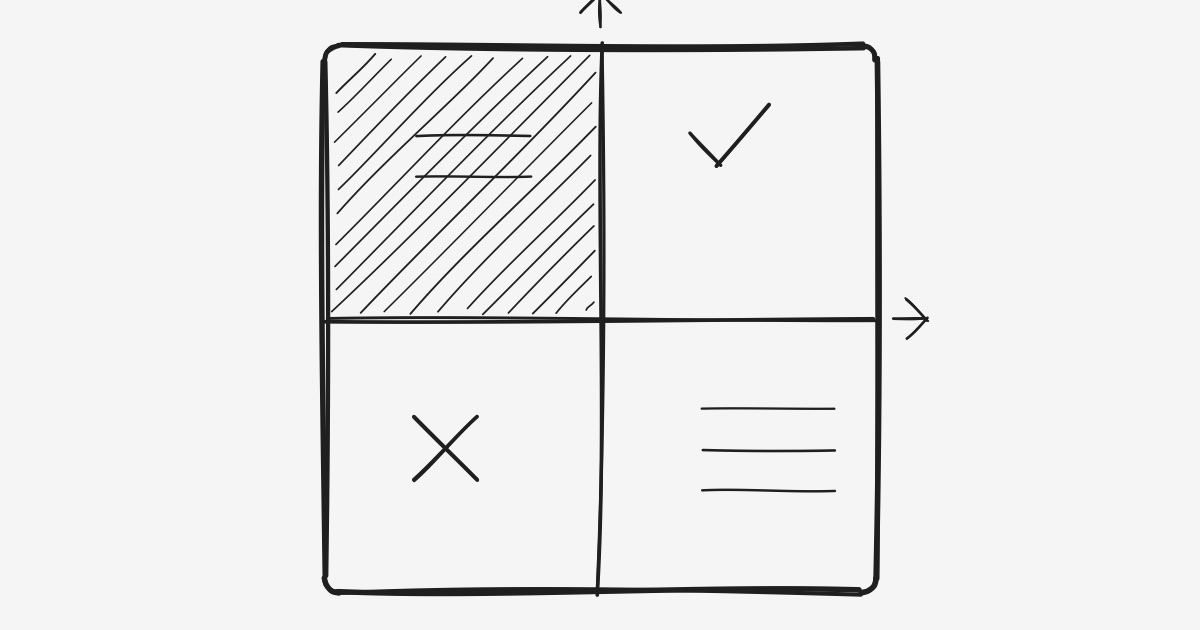
The Eisenhower Matrix is a devastatingly simple tool for escaping that trap. In four boxes, it forces you to separate two things we constantly confuse: urgency and importance.
Contents
- What is the Eisenhower Matrix?
- The four quadrants
- How to use it day to day
- Real examples
- Urgent vs important: the real trap
- Common mistakes
- FAQ
- Conclusion
What is the Eisenhower Matrix?
It's a two-axis grid that sorts your tasks by two criteria:
- Importance: does the task contribute to your deeper goals?
- Urgency: does it demand immediate action?
The crossing gives four quadrants, each tied to a clear action: do, plan, delegate or eliminate. The point isn't to "tidy" your tasks for its own sake, but to decide what to do with them.
The four quadrants
Quadrant 1 — Urgent and important: do now
Crises, imminent deadlines, problems that can't wait. Handle them immediately. The long-term goal: have as few as possible, since they're often the symptom of neglected quadrant 2.
Quadrant 2 — Important but not urgent: schedule
The heart of the method. Strategy, prospecting, learning, prevention, health. These tasks have no deadline, so we postpone them — and that's exactly why they make the difference long-term. Block time for them in advance.
Quadrant 3 — Urgent but not important: delegate
Interruptions, some meetings and requests, most notifications. They demand your attention without serving your goals. Delegate, automate, or handle them fast and in batches.
Quadrant 4 — Neither urgent nor important: eliminate
Wasted time: endless scrolling, tasks "done out of habit" that add nothing. Cut them without guilt.
How to use it day to day
- List your tasks for the day or week.
- Sort each into a quadrant, honestly — the mistake is dumping everything into "urgent and important."
- Act by quadrant: do Q1, schedule Q2, delegate Q3, eliminate Q4.
- Protect quadrant 2. Reserve fixed slots for it (see time blocking), or urgency will devour them.
Real examples
Freelancer: answering a proposal that closes tomorrow is Q1. Prospecting to fill next month's schedule is Q2 (important, never urgent — so always postponed). An email "can you send me that?" is often Q3. Checking your stats ten times a day is Q4.
Small team: a blocking production bug is Q1. Documenting a process to prevent that bug in future is Q2. A "just to catch up" meeting with no agenda is often Q3.
Urgent vs important: the real trap
Our brain is drawn to urgency: a notification, a deadline, a ring create instant satisfaction when we respond. Importance, by contrast, is silent — nothing reminds you to work on what truly matters.
The result: without conscious effort, we live in quadrants 1 and 3, and neglect 2. Ultimately the matrix does just one thing: it makes that trade-off visible so you can take back control.
Common mistakes
- Classifying everything as "urgent and important." If everything is a priority, nothing is. Be ruthless.
- Mistaking others' urgency for your priorities. A request urgent for someone else isn't necessarily important for you.
- Ignoring quadrant 2. The most costly mistake long-term.
- Turning it into a bureaucracy. The matrix is a fast decision tool, not a spreadsheet to maintain.
FAQ
How do I know if a task is important or just urgent?
Ask: "If I don't do it, what are the real long-term consequences?" An urgent task creates immediate pressure; an important task has a lasting impact on your goals.
Does the Eisenhower Matrix work for teams?
Yes, very well for collectively deciding what deserves the team's attention and what can be delegated or dropped. It clarifies shared priorities.
Eisenhower Matrix or Pareto principle?
They complement each other: Eisenhower helps you sort by urgency/importance; the Pareto principle helps you spot the 20% of tasks that produce 80% of results.
How often should I use it?
A quick review each morning (or weekly) is enough. The goal is to anchor the habit of separating urgent from important, not to fill boxes constantly.
Conclusion
The Eisenhower Matrix won't give you more time, but it will help you spend it where it counts — by making visible the difference between being busy and making progress.
The real test is knowing where your time actually goes across those four quadrants. It's often a revelation: by tracking your time, you discover how many hours go to Q3 "urgent but not important." Puuunch helps you see it, project by project, in seconds of logging a day. See how it works.